
4 min read
Updated
Origin of the Scrum Chicken and Pig Cartoons
The Scrum Chicken and Pig story: what 'committed vs. involved' meant, who drew the cartoons, why Scrum stopped using the terms, and what still applies.
The Scrum Chicken and Pig story is a joke about commitment: in a ham-and-eggs breakfast, the chicken is involved but the pig is committed. In 2006 I started publishing it as a weekly cartoon at ImplementingScrum.com, drawn by Tony Clark. Calling people “chickens” and “pigs” is history now. The question behind it is not.
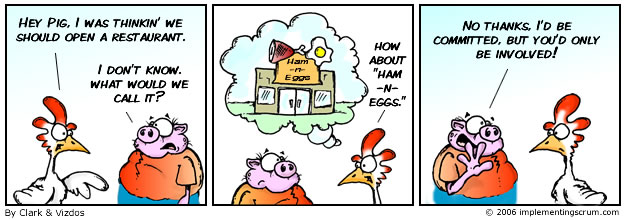
The first one, September 11, 2006. © 2006 ImplementingScrum.com. Illustrated by Clark, concept by Vizdos.
What did “chicken” and “pig” mean in Scrum?
- Pigs were the people doing the work. They are committed: they have skin in the game. Think Developers today.
- Chickens were the people with ideas about how the work should get done, but who weren’t doing it. They are involved, not committed. Think stakeholders today.
The joke lands because the chicken gets a restaurant out of the deal and the pig gets, well, bacon.
In those early days the Product Owner was still a “chicken.” Decoupling that idea took years. Now the Product Owner is an accountability (aka role) on the Scrum Team, and the Scrum Guide no longer uses the chicken and pig vocabulary.
Where did the Scrum Chicken and Pig story come from?
Ken Schwaber told it to my class in January 2004, when I took what was evolving into the Certified Scrum Master course.
By 2006 I was fifteen years into my career, fresh off co-authoring a book with Scott Ambler, and deep in a multi-year engagement with a large financial services firm. I’d also become a Certified Scrum Trainer® (CST). I’d been telling the chicken and pig story for years, and I kept asking around for someone who had drawn it. Nobody had.
One problem. I can’t draw.
So I put the word out and finally found Tony Clark, who wasn’t in the Agile or Scrum community at all, but the idea resonated with him. He agreed to illustrate the ideas I came up with. On September 11, 2006, we published the first Scrum Chicken and Pig cartoon on a brand new site, ImplementingScrum.com.
How long did the cartoon series run?
About five years, until roughly 2011. Each week Tony and I bounced ideas back and forth. He illustrated; we co-created the concepts (any errors are mine). We published over a hundred cartoons, and the original was translated into more than a dozen languages. It’s on my Product Backlog to publish those translations again.
The early reaction from peers wasn’t kind. It kinda took on a life of its own anyway, and the people who thought it was a dumb idea changed their minds.
When we ended the series, all the content and rights were signed over to me. Tony went on to do incredible things with his life.
Do Scrum chickens and pigs still apply today?
The words, no. The idea, yes.
Splitting people into “in” and “out” was always a little too tidy. It’s why the terms faded, and I think that was the right call. But the question underneath is still the one I ask every team:
Who is committed to the outcome here, and who is only weighing in?
If you’re a Scrum Team, make sure the people who need to be committed actually are: the Product Owner, the Scrum Master, the Developers. If you’re a stakeholder, bring your ideas, and show up at the Sprint Review to hear what the team learned. Everyone is involved. The point is to know which of those you are.
Kirk Israel wrote a nice reflection on this too: The Chicken and the Pig.
What happened to ImplementingScrum.com?
Over 20 years I’ve tried many versions of the site. These days you can see the original cartoon and learn about starting, practicing, coaching, and leading (not managing) Scrum in the real world, where you and I live and breathe. If you’re curious about the earlier years, try the Internet Archive’s copy.
I’m not drawing new cartoons, but I have kept the habit. For 20 years I’ve sent a weekly email with a fresh point of view built around one of the original strips. It goes out on Saturday morning to thousands of people like you and me. Subscribe here. You don’t have to read it on the weekend.
What next?
- New to Scrum? Start with Scrum Fundamentals, then the Interactive Scrum Guide.
- Want more origin stories? Here’s where Scrum’s name came from.
- Want help with your team? See training, consulting, and mentoring.
I’d like to hear your story too. Email me with feedback, or connect with me on LinkedIn. One of your experiences may wind up shared with our community of Scrum and Agile people around the world.
Weekly, free, no fluff
Get one actionable Scrum idea a week.
Saturday morning emails on Implementing Scrum in the real world — the same cartoons and straight talk that built this site.
Subscribe — It's FreeStuck on something specific? Email me your situation.
